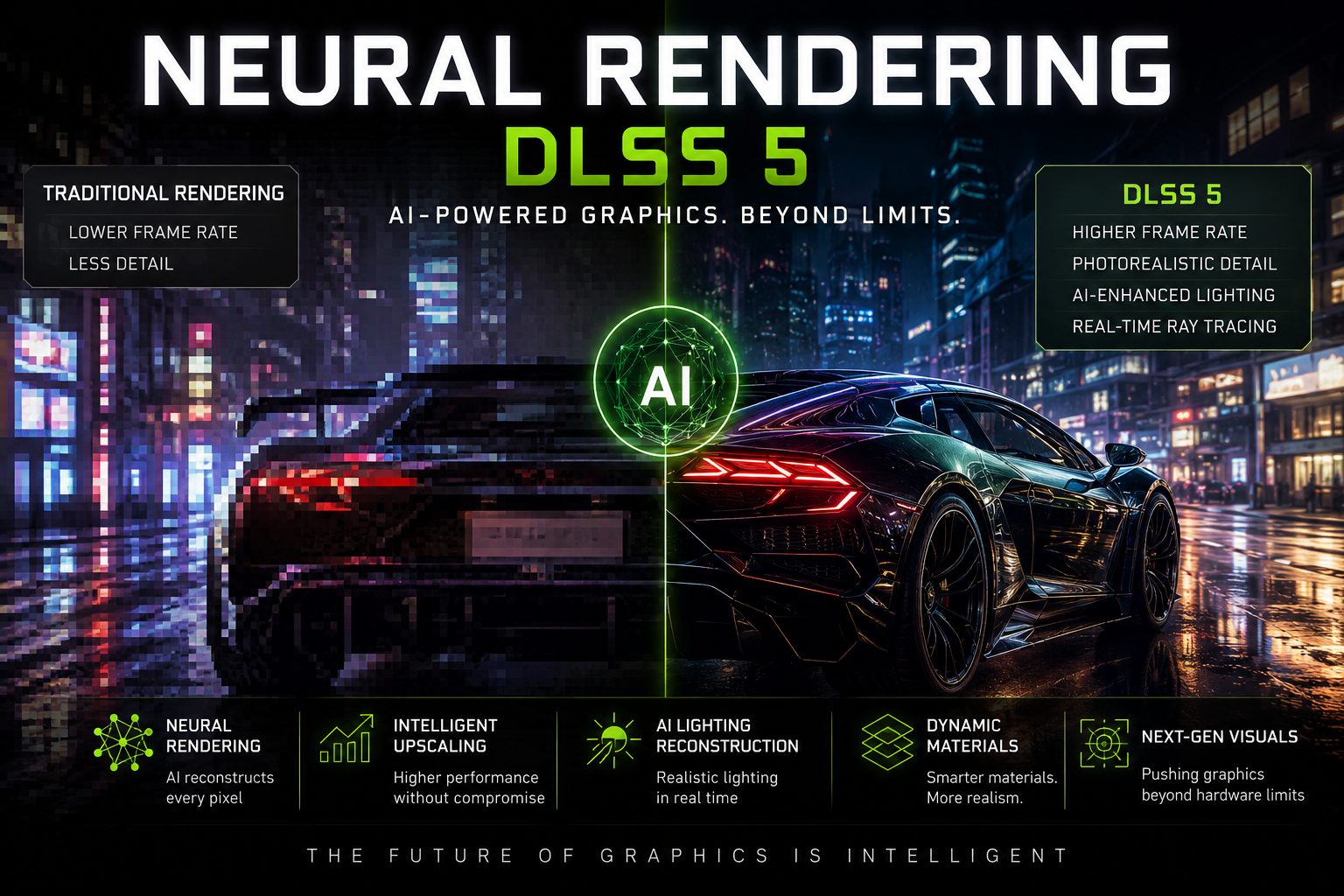
The gaming and visualization industry is entering a new era where artificial intelligence is no longer just assisting artists—it is actively participating in the rendering process itself. At the forefront of this revolution is Neural Rendering, powered by advanced technologies such as DLSS 5 (Deep Learning Super Sampling). These breakthroughs are transforming how games, films, virtual production environments, and real-time simulations are created and experienced.
For decades, graphics quality was primarily limited by raw hardware performance. More powerful GPUs meant more polygons, higher resolutions, and better lighting. Today, AI is changing that equation by generating, reconstructing, and enhancing visual information in real time, pushing graphics beyond traditional hardware limitations.
What Is Neural Rendering?
Neural Rendering combines conventional graphics pipelines with deep learning models. Instead of calculating every pixel through traditional rendering methods, AI neural networks intelligently predict and reconstruct image details, lighting information, reflections, shadows, and materials.
Think of it as having a highly trained digital artist working alongside your GPU, filling in missing details and improving image quality frame by frame.
This approach allows systems to deliver visuals that appear significantly more detailed than what the hardware could normally render in real time.
The Evolution from DLSS to DLSS 5
NVIDIA’s Deep Learning Super Sampling (DLSS) technology has evolved dramatically since its first release.
DLSS 1
- Basic AI image reconstruction
- Improved performance but limited visual consistency
DLSS 2
- Temporal AI upscaling
- Sharper images
- Major performance gains
DLSS 3
- Frame Generation
- AI-created intermediate frames
- Higher frame rates
DLSS 4
- Enhanced multi-frame generation
- Improved latency management
- Better image reconstruction
DLSS 5
- Neural Rendering integration
- AI-assisted ray tracing reconstruction
- Dynamic material enhancement
- Neural lighting prediction
- Photorealistic image synthesis
DLSS 5 represents a significant leap because it moves beyond simple upscaling and begins generating actual visual information using neural networks.
Breaking Hardware Barriers
Traditionally, achieving photorealistic graphics required enormous computational power.
Challenges included:
- Complex ray tracing calculations
- High-resolution textures
- Global illumination simulations
- Real-time reflections
- Physically accurate shadows
Neural rendering changes this paradigm.
Instead of calculating every ray of light, AI models learn how light behaves and reconstruct realistic lighting effects using significantly less computational effort.
The result is:
- Higher frame rates
- Lower GPU load
- Improved image quality
- Reduced rendering costs
AI-Powered Lighting Reconstruction
One of the most exciting developments in DLSS 5 is neural lighting reconstruction.
Traditional ray tracing requires millions of light calculations every second.
Neural models can:
- Predict indirect lighting
- Reconstruct missing light bounces
- Enhance reflections
- Generate realistic ambient illumination
- Reduce visual noise
This creates scenes that look more cinematic while maintaining real-time performance.
Imagine a sunset reflecting across a wet street or sunlight filtering through a forest. Neural rendering can recreate these complex interactions with remarkable realism.
Dynamic Material Intelligence
Modern games contain thousands of materials:
- Metal
- Glass
- Fabric
- Skin
- Water
- Stone
- Plastic
DLSS 5’s neural models understand how these surfaces interact with light.
Rather than relying solely on precomputed data, AI dynamically reconstructs material responses in real time.
Benefits include:
More Realistic Metals
Improved reflections and surface roughness.
Better Skin Rendering
Natural subsurface scattering and lifelike appearance.
Enhanced Water Simulation
More believable transparency and reflections.
Detailed Surface Textures
Sharper visual detail without larger texture files.
Real-Time Upscaling Like Never Before
One of the greatest strengths of neural rendering is intelligent upscaling.
Instead of rendering at native 4K resolution, a game may render internally at a lower resolution while AI reconstructs a near-native or even superior image.
Advantages include:
- Increased FPS
- Reduced VRAM usage
- Lower power consumption
- Improved thermal efficiency
For gamers, this means smoother gameplay without sacrificing visual quality.
The Future of Ray Tracing
Ray tracing remains one of the most demanding graphics technologies.
Neural rendering helps solve its biggest challenge: computational expense.
Future rendering pipelines may use:
- Partial ray tracing
- AI-assisted light prediction
- Neural denoising
- Dynamic scene reconstruction
The result could be cinematic-quality lighting running on mainstream hardware.
Impact on Game Development
Developers benefit enormously from neural rendering technologies.
Faster Development Cycles
Less time spent optimizing graphics for different hardware levels.
Broader Hardware Compatibility
High-end visuals become accessible to more players.
Reduced Production Costs
AI handles many visual enhancement tasks automatically.
Greater Creative Freedom
Artists can focus on storytelling and design rather than technical limitations.
Beyond Gaming
Neural rendering is not limited to video games.
Industries already exploring these technologies include:
Virtual Production
Real-time film sets powered by game engines.
Architecture
Photorealistic building visualization.
Automotive Design
Real-time vehicle simulations.
Medical Visualization
Advanced scientific rendering.
Digital Twins
Interactive simulations of real-world systems.
Challenges Ahead
Despite its enormous promise, neural rendering still faces challenges:
- Increased AI model complexity
- Training data requirements
- Memory bandwidth demands
- Latency optimization
- Standardization across hardware platforms
As AI hardware accelerators continue to improve, these obstacles are expected to diminish rapidly.
The Beginning of a New Graphics Era
Neural rendering and DLSS 5 represent one of the biggest shifts in computer graphics since programmable shaders and real-time ray tracing.
For the first time, graphics quality is no longer determined solely by brute-force hardware performance. AI is becoming an active participant in image creation, reconstructing lighting, enhancing materials, generating frames, and delivering photorealistic visuals that were previously impossible in real time.
The future of graphics is not just faster GPUs—it is smarter rendering.
As neural rendering technologies continue to evolve, we are moving closer to a world where real-time graphics become virtually indistinguishable from reality.